

Johannes Brahms Biography - A Very Quick Guide
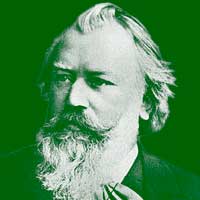
Artist:
Johannes Brahms
Born:
1833, Hamburg
Died:
1897, Vienna
Who was Johannes Brahms?
Johannes Brahms (1833–1897) was a German Romanic-era composer. He was born on 3rd April 1833 in Hamburg to a family of modest means. His father was musical, playing double bass, horn and flute in a Hamburg orchestra. His mother was a seamstress.
Brahms’ early life.
Though Brahms family were not rich, they were able to support their young sons’ burgeoning musical talents. He began composing at an early age, though his parents were more keen to support a potential career as a pianist, considering it to be more lucrative. He made his public debut as a soloist in 1847, a full recital in 1849 also including one of his own compositions.
Brahms continued to study the piano, but became increasingly interested in composition. A period of travel in the 1850s included the forging of friendships with violinists Ede Reményia and Joseph Joachim and pianist-composers Clara and Robert Schumann. He took conducting posts Detmold and Hamburg, eventually deciding to settle in Vienna in 1869.
What was his personality like?
Brahms was an intensely private man, intellectually serious, dry-humoured and sometimes brusque. In his personal life he was capable of strong emotion, falling in love several times during his life, though he was never to marry. He was generous and loyal to his friends and sometimes even to his enemies—he continued to recognise the qualities of Richard Wagner even after that composer had been critical of Brahms. He was a supreme craftsman, his dedication to his art creating an aura of reserve as much as the inherent qualities of his personality.
What were the major influences on Brahms’ music?
Brahms’s style is strongly shaped by the Classical tradition of Bach, Haydn, Mozart and Beethoven, to which he is often seen as the natural heir. Other influences include German folk song, early polyphonic composers such as Schütz and Palestrina and the poetry and musical ideals of the Schumann circle.
The stylistic traits of Brahms’ music.
Brahms music is known for his intricate counterpoint; motivic development; structural clarity; enriched, but still tonal, harmony; synthesis of Classical forms with Romantic expressivity; and orchestration that avoids brilliance or over-abundance for its own sake.
What types of music did he write?
Brahms composed in most major genres except opera: symphonies, concertos, chamber music, solo piano works, choral compositions, art songs (Lieder), and large vocal-orchestral works such as the German Requiem. Chamber music occupies a particularly central place in his output.
Some of Brahms’ important works
–Piano Quintet in F minor, Op. 34 (1862–1864)
–German Requiem, Op. 45 (1865–1868)
–Variations on a Theme by Haydn, Op. 56a (1873)
–String Quartet No. 1 in C minor, Op. 51 No. 1 (1873)
–Symphony No. 1 in C minor, Op. 68 (1876)
–Violin Concerto in D major, Op. 77 (1878)
–Piano Concerto No. 2 in B-flat major, Op. 83 (1881)
–Symphony No. 4 in E minor, Op. 98 (1884–1885)
Brahms and the New German School
The New German School of composers, led by Franz Liszt and Richard Wagner, advocated programmatic music, radically unusual or expanded forms and the chromatic expansion of tonal harmony, eventually threatening its very stability. In this context Brahms’ music, which prioritised absolute music and the continued development of Classical principles, was considered old-fashioned. The debate was inflamed by critics such as Eduard Hanslick, who sided with the Brahms in the ‘War of the Romantics.’
Why is his music important?
The conspicuous quality of Brahms’ oeuvre is of course one compelling reason why his music continues to be played today—a composer does not need to be radical to be important. Brahms also offers a compelling model for how traditional forms could be married with modern harmonic and motivic thinking. In demonstrating this, he exerted a profound influence on other composers of the day, including Ferruccio Busoni, Robert Fuchs and Antonín Dvořák.
The influence also extends beyond his lifetime and to the present day. His structural rigour inspired both Arnold Schoenberg and Anton Webern, who cited Brahms’ technique of ‘developing variation’ as a precursor to twentieth-century techniques. His treatment of meter, motives, rhythm and texture has inspired figures such as diverse as Milton Babbitt, Elliott Carter, György Ligeti, Wolfgang Rihm and Thomas Adès.
How did Brahms die?
Brahms health declined significantly in 1897, though he remained mentally sharp and socially active. He made his last public appearance at a concert of his Fourth Symphony on 7th March by the Vienna Philharmonic, the audience, aware of his failing health, rapturously applauding every movement.
He died at his apartment in Vienna from complications of liver cancer at the age of 63.
Useful resources:
–Brahms‑Institut an der Musikhochschule Lübeck
–Library of Congress Guide: Johannes Brahms: A Guide to Primary and Secondary Sources
–Wikipedia: entry on Brahms
–8notes Collection: Free Brahms Sheet Music
Top Pieces on 8notes by Johannes Brahms