

Claude Debussy - Biography
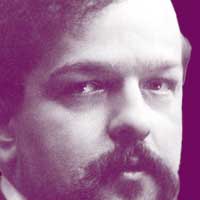

Claude Debussy Biography

Claude Achille Debussy (August 22, 1862 – March 25, 1918), composer of impressionistic classical music.
Born in Saint-Germain-en-Laye, Yvelines, France, Claude Debussy studied with Guiraud and others at the Paris Conservatoire (1872-84) and as an 1884 Prix de Rome winner, went to Rome, Italy (1885–7), though more important impressions came from his visits to Bayreuth (1888, 1889) and from hearing Javanese gamelan music in Paris (1889).
Wagner's influence is evident in the cantata La damoiselle élue (1888) and the Cinq poèmes de Baudelaire (1889) but other songs of the period, notably the settings of Verlaine (Ariettes oubliées, Trois mélodies, Fêtes galantes, set 1) are in a more capricious style, as are parts of the still somewhat Franckian G minor String Quartet (1893); in that work he used not only the Phrygian mode but also less standard modes, notably the whole-tone mode, to create the floating harmony he discovered through the work of contemporary writers: Mallarmé in the orchestral Prélude à 'L'après-midi d'un faune (1894 - in 1912 used as music for the L’Après-midi d’un Faune ballet production) and Maeterlinck in the opera Pelléas et Mélisande, dating in large part from 1893-5 but not completed until 1902. These works also brought forward a fluidity of rhythm and color quite new to Western music.
Pelléas, with its rule of understatement and deceptively simple declamation, also brought an entirely new tone to opera — but an unrepeatable one. Debussy worked on other opera projects and left substantial sketches for two pieces after tales by Edgar Allan Poe (Le diable dans le beffroi and La chute de la maison Usher), but neither was completed. Instead, the main works were orchestral pieces, piano sets, and songs.
Among his major orchestral works are the three Nocturnes (1899), characteristic studies of veiled harmony and texture ('Nuages'), exuberant cross-cutting ('Fêtes') and seductive whole-tone drift ('Sirènes'). La mer (1905) essays a more symphonic form, with a finale that works themes from the first movement, though the centerpiece (Jeux de vagues) proceeds much less directly and with more variety of color. The three Images (1912) are more loosely linked, and the biggest, Ibéria is itself a triptych, a medley of Spanish allusions. Finally, the ballet Jeux (1913) contains some of Debussy's strangest harmony and texture in a form that moves freely over its own field of motivic connection. Other late stage works, including the ballets Khamma (1912) and La boîte à joujoux (1913) and the mystery play Le martyre de St. Sébastien (1911), were not completely orchestrated by Debussy, though St. Sébastien is remarkable in sustaining an antique modal atmosphere that otherwise was touched only in relatively short piano pieces (eg.La cathédrale engloutie).
Debussy wrote much piano music although the most important of them to begin with are works which, Verlaine fashion, look back at rococo decorousness with a modern cynicism and puzzlement (Suite bergamasque, 1890; Pour le piano, 1901). His first volume of Images pour piano 1904 - 1905 evokes tonality that was rarely heard in works by his contemporaries such as phrases suggesting the rippling of water in the first piece Reflets dans l'eau as well as a homage to Jean-Philippe Rameau's influence in a slow and mysterious court dance in the second piece Hommage à Rameau. But then, as in the orchestral pieces, Debussy began to associate his music with visual impressions of the East, Spain, landscapes etc, in a sequence of sets of short pieces. This can be heard in the volume of pieces known as Estampes which was composed in 1903 and features pieces suitably entitled such as Pagodes which invokes a feel of the Orient and of magnificent pagodas and its imposing turrets. The second piece in Estampes entitled La soirée dans Grenade vividly recalls a Spanish atmosphere. Even in his famous Children's Corner Suite for piano, which he wrote for his beloved daughter whom he called Chou-chou also suggests influences from the Orient as well as a new wave of jazz influence although Debussy also has a laugh at Richard Wagner in the piece Golliwogg's Cake-walk.
His last volume of Etudes (1915) interprets similar varieties of style and texture purely as pianistic exercises and includes pieces that develop irregular form to an extreme as well as others influenced by the young Stravinsky (a presence too in the suite En blanc et noir for two pianos, 1915). The rarefaction of these works is a feature of the last set of songs, the Trois poèmes de Mallarmé (1913), and of the Sonata for flute, viola and harp (1915), though the sonata and its companions also recapture the inquisitive Verlainian classicism. The planned set of six sonatas was cut short by the composer's death in 1918 from rectal cancer.
Claude Debussy died in Paris on March 25, 1918 during World War I and a siege by the Prussian army who pounded Paris from the 'Big Bertha' gun not far from the capital city. He was interred there in the Cimetière de Passy. Debussy's death as well as the World War I coincided with the sad end of the Belle Epoque era which witnessed Paris blooming with sophistication and modernity as never seen before in Europe.
Rudolph Réti points out these features of Debussy's music which 'established a new concept of tonality in European music':
- Frequent use of long pedal points
- Glittering passages and webs of figurations which distract from occasional absence of harmony
- Frequent use of parallel chords which are 'in essence not harmonies at all, but rather 'chordal melodies', enriched unisons.'
- Bitonality, or at least bitonal chords
- 'Use of the whole-tone scale.'
- Unprepared modulations, 'without any harmonic bridge.'
He concludes that Debussy's achievement was the synthesis of monophonic based 'melodic tonality' with harmonies, albeit different from those of 'harmonic tonality'. (Reti, 1958)
Other related articles
- Compositions
- Contemporaries
External link
- Wikiquote - Quotes by and about Claude Debussy (http://en.wikiquote.org/wiki/Claude_Debussy)
- CarolinaClassical.com: Claude Debussy and Impressionism (http://www.carolinaclassical.com/articles/debussy.html) by Charles K. Moss, M.M.Ed., M.Mus.
- Piano Society.com - Debussy (http://www.pianosociety.com/index.php?id=88) - A short biography and various free recordings in MP3 format
Source
- Reti, Rudolph (1958). Tonality, Atonality, Pantonality: A study of some trends in twentieth century music. Westport, Connecticut: Greenwood Press. ISBN 0313204780.
This biography is published under the GNU Licence