

Heitor Villa-Lobos - Biography
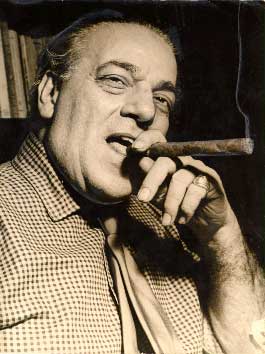
Heitor Villa-Lobos Biography
Heitor Villa-Lobos (March 5, 1887 - November 17, 1959) was a Brazilian composer.
Heitor Villa-Lobos, also known as Hector Villa-Lobos, was born in Rio de Janeiro. He learned music from his father, who was a widely-read, highly-cultured amateur musician (and a librarian). By 1899, when his father died, Villa-Lobos had turned himself into a professional musician. He earned his living as a cafe musician, playing the cello.
In 1905 Villa-Lobos made the first of his trips to Brazil's north-eastern states, to collect folk music. He made many such trips and Villa-Lobos spun a web of mystery around them. His own testimony of adventures with the cannibal tribes of the North-East is not always trustworthy. Afterwards, he studied at the National Institute of Music in Rio de Janeiro, though his compositional style never conformed to any academic norms. His music remained always personal and idiosyncratic. As Villa-Lobos himself said many years later: 'My music is natural, like a waterfall.' Also: 'One foot in the academy and you are changed for the worst!'
After another ethno-musicological trip to the Amazonian interior in 1912, Villa-Lobos returned to Rio de Janeiro. There, on November 13, 1915, he turned the city on its ear with a concert of his new music. By 1923, he had attracted enough official favour to win a government grant to study in Paris. On his return in 1930, Villa-Lobos was made director of music education in Rio de Janeiro.
Thus began Villa-Lobos' glorious second career: pedagogue of music for his country. He designed a complete system of musical instruction for generations of Brazilians, based upon Brazil's rich musical culture, and rooted in a deep and always explicit patriotism. He composed choral music for huge choirs of school children, often adaptations of folk material. His legacy in the Brazil of today, even amongst new generations brought up with the samba-schools or MTV, is a strong feeling of pride and love, intertwined with similar feelings for their country. This is surprising, considering that this is a 'classical' composer dead now for more than 40 years; a North American parallel would be hard to find.
In 1944, Villa-Lobos made a trip to the United States to conduct his works, to critical and even some popular acclaim. Important new works were commissioned by American orchestras, and he even wrote a movie score for Hollywood, for the interesting 1945 film Green Mansions. The 1940s were a period of triumph on an international scale. As a composer and conductor of his own music, Villa-Lobos was lionized from Los Angeles to New York to Paris. In spite of his world travels, his home was always in Rio de Janeiro, where he died.
Major Works
Villa-Lobos was notoriously prolific, though he probably himself exaggerated the number of works he wrote. Many works are arrangements of earlier pieces. Especially in his final years, Villa-Lobos did a lot of re-composing.
The works below represent his musical legacy. Except for the lost works, they are well represented on the world's recital and concert stages and on CD. Even the Symphonies are now available in an integral recording on the cpo label - see http://www.rdpl.org/villa/stuttgart.html. Exceptions include the Nonetto and the operas.
Villa-Lobos' most popular work is the 5th Bachianas Brasileiras, written for voice and eight cellos, but performed in many other instrumental combinations. Close runner-ups would include the music for solo guitar, including the preludes, etudes and Choros 1. The greatest music is included in the Choros, Bachianas Brasileiras and String Quartet series, while a number of works for solo piano - Choros 5 and Bachianas Brasileiras 4, for example - are highly prized by pianists and audiences alike.
- Bachianas Brasileiras
- No. 1 for 8 cellos (1932)
- No. 2 for chamber orchestra (1933)
- No. 3 for piano and orchestra (1934)
- No. 4 for piano (1930-40); orchestrated in 1942
- No. 5 for voice and 8 cellos (1938)
- No. 6 for flute and bassoon (1938)
- No. 7 for orchestra (1942)
- No. 8 for orchestra (1944)
- No. 9 for chorus or string orchestra (1944)
- Choros
- Intoduction to Choros for guitar & orchestra (1929)
- No. 1 for guitar (1920)
- No. 2 for flute & clarinet (1921)
- No. 3 for male chorus & wind instruments (1925)
- No. 4 for 3 horns & trombone (1926)
- No. 5 for piano (1926) 'Alma Brasileira'
- No. 6 for orchestra (1926)
- No. 7 for winds, violin & cello (1924)
- No. 8 for large orchestra & 2 pianos (1925)
- No. 9 for orchestra (1929)
- No. 10 for chorus & orchestra (1925) 'Rasga o Coraçao'
- No. 11 for piano & orchestra (1928)
- No. 12 for orchestra (1929)
- No. 13 for 2 orchestras & band (1929) - LOST
- No. 14 for orchestra, band & chorus (1928) - LOST
- Choros bis, for violin & cello (1928)
- Concertos
- Suite for Piano and Orchestra (1913)
- Cello Concerto no. 1 (1915)
- Momoprécoce, fantasy for piano and orchestra (1921)
- Fantasia de Movimentos Mistos, for violin & orchestra (1921)
- Ciranda das Sete Notas for basson & string orchestra (1933)
- Piano Concerto no. 1 (1945)
- Piano Concerto no. 2 (1948)
- Piano Concerto no. 3 (1952-57)
- Piano Concerto no. 4 (1952)
- Piano Concerto no. 5 (1954)
- Fantasia for soprano saxophone, three horns & strings (1948)
- Concerto for Guitar (1951)
- Harp Concerto (1953)
- Cello Concerto no. 2 (1953)
- Fantasia for Cello and Orchestra
- Harmonica Concerto
- Concerto Grosso for wind quartet & wind ensemble (1959)
- Chôros no. 11 and Bachianas no. 3 are also concertante pieces for piano and orchestra
- Symphonies
- No. 1 O Imprevisto, The Unforseen (1920)
- No. 2 Ascenção, The Ascension (1917)
- No. 3 A Guerra, The War (1919)
- No. 4 A Vitória, The Victory (1919)
- No. 5 A Paz, The Peace (1920) - LOST
- No. 6 Montanhas do Brasil, The Mountains of Brasil (1944)
- No. 7 (1945)
- No. 8 (1950)
- No. 9 (1951)
- No. 10 Sumé Pater Patrium, Amerindia (1952)
- No. 11 (1955)
- No. 12 (1957)
- Other Orchestral Works (including Ballet scores)
- Tédio de Alvorada, symphonic poem (1916)
- Naufrágio de Kleônicos, symphonic poem (1916)
- Dancas Africanas (1916)
- Sinfonietta no. 1 (1916)
- Iára (1917)
- Amazonas, ballet & symphonic poem (1917)
- Uirapuru, ballet (1917)
- Danca Frenetica (1918)
- Danca dos Mosquitos (1922)
- Francette et Piá (1928, orch. 1958)
- Rudepoema (1926, orch. 1932)
- O Papagaio do moleque, the Kite of the Guttersnipe, a symphonic episode (1932)
- Caixinha de Boas Festas, symphonic poem & ballet (1932)
- Evolução dos Aeroplanos (1932)
- Danca da terra, ballet (1939)
- Mandú-Cárárá, Profane Cantata / Children's Ballet for mixed choir, children's choir & orchestra (1940)
- Suite Saudade da Juventude nr. 1 (1940)
- Madona, symphonic poem (1945)
- Sinfonietta no. 2 (1947)
- Erosão, Erosion, symphonic poem (1950)
- Rudá, symphonic poem & ballet (1951)
- Ouverture de L'Homme Tel (1952)
- Alvorada na Floresta Tropical, ouverture (1953)
- Odisséia de uma raça, symphonic poem (1953)
- Gênesis, symphonic poem & ballet (1954)
- Emperor Jones, a ballet (1956)
- Fantasia em Três Movimentos (in body of choros)(1958)
- Suite no. 1 for chamber orchestra (1959)
- Suite no. 2 for chamber orchestra (1959)
This biography is published under the GNU Licence