

Antonio Vivaldi - Biography
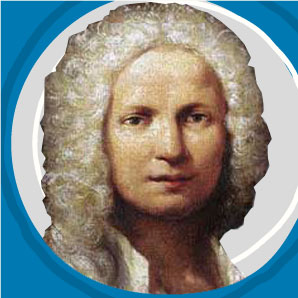

Antonio Vivaldi Biography

Antonio Vivaldi (March 4, 1678, Venice – July 28, 1741, Vienna), nicknamed Il Prete Rosso, meaning 'The Red Priest,' was an Italian priest and baroque music composer.
His father, a barber and a talented violinist himself (some have said he was a virtuoso), had helped him in trying a career in music and made him enter the Cappella di San Marco orchestra, where he was an appreciated violinist.
In 1703 Vivaldi became a priest, soon nicknamed Il Prete Rosso, 'The Red Priest', probably because of his red hair. Not long after, in 1704, he was given a dispensation from celebrating the Holy Mass because of his ill-health (he apparently suffered from asthma), and became a violin teacher at an orphanage for girls called the Pio Ospedale della Pietà in Venice. Shortly after his appointment, the orphans began to gain appreciation and esteem abroad too; Vivaldi wrote for them most of his concertos, cantatas, and sacred music. In 1705 the first collection (raccolta) of his works was published. Many others would follow. At the orphanage he covered several different duties, with the only interruption for his many travels, and in 1713 became responsible for the musical activity of the institute.
Not so well known is the fact that most of his repertoire was re-discovered only in the first half of the 20th century in Turin and Genoa, but was published in the second half. Vivaldi's music is innovative, breaking a consolidated tradition in schemes; he gave brightness to the formal and the rhythmic structure of the concerto, repeatedly looking for harmonic contrasts, and invented innovative melodies and themes. Moreover, Vivaldi was able to compose non-academic music, particularly meant to be appreciated by the wide public, and not only by an intellectual minority. The joyful appearance of his music reveals in this regard a transmissible joy of composing. These are among the causes of the vast popularity of his music. This popularity soon made him famous also in countries like France, at the time very closed into its national schemes.
He is considered one of the composers who brought Baroque music (with its typical contrast among heavy sonorities) to evolve into an impressionist style. Vivaldi has been also indicated as a precursor of romantic musicians. Johann Sebastian Bach was deeply influenced by Vivaldi's concertos and arias (recalled in his Passions and cantatas). Bach transcribed a number of Vivaldi's concertos for solo keyboard, along with a number for orchestra, including the famous Concerto for Four Violins and Violoncello, Strings and Continuo (RV 580). However, not all the musicians showed the same enthusiasm: Igor Stravinsky provocatorily said that Vivaldi had not written hundreds of concertos, but one concerto, repeated hundreds of times.
Despite his saintly status, he is supposed to have had many love affairs, one of which was with the singer Anna Giraud, with whom he was suspected of using materials from old Venetian operas that he only slightly adapted to the vocal capabilities of his mistress. This business caused him some troubles with other musicians, like Benedetto Marcello, who wrote a pamphlet against him.
Vivaldi's life, like those of many composers of the time, ended in poverty. His compositions no longer held the high esteem they once did in Venice; changing musical tastes quickly made them outmoded, and Vivaldi, in reponse, chose to sell off sizeable numbers of his manuscripts at paltry prices to finance a migration to Vienna. Reasons for Vivaldi's departure from Venice are unclear, but it seems likely that he wished to meet Charles VI, who adored his compositions (Vivaldi dedicated La Cetra to Charles in 1727), and take up the position of royal composer in his Imperial Court. But shortly after Vivaldi's arrival at Vienna, Charles died. This tragic stroke of bad luck left the composer without royal protection and a source of income. Vivaldi had to sell off more manuscripts to make ends meet, and eventually died not long after, in 1741. He was given an unmarked pauper's grave (the assumption that the young Joseph Haydn sang in the choir at Vivaldi's burial was based on the mistranscription of a primary source and has been proven wrong). Equally unfortunate, his music was to fall into obscurity until the 1900s.
The resurrection of Vivaldi's works in the 20th century is mostly thanks to the efforts of Alfredo Casella, who in 1939, organised the now historic Vivaldi Week. Since then, Vivaldi's compositions have enjoyed almost universal success, and the advent of historically informed performance has all but catapulted him to stardom once again. In 1947, the Venetian businessman Antonio Fanna founded the Istituto Italiano Antonio Vivaldi, with the composer Gian Francesco Malipiero as its artistic director, with the purpose of promoting Vivaldi's music and putting out new editions of his works.
Vivaldi's music, together with Mozart's, Tchaikovsky's and Corelli's, has been included in the theories of Alfred Tomatis on the effects of music on human behaviour, and used in music therapy.
He was a prolific composer and is most well-known for composing:
- over 500 concertos (210 of which for violin or violoncello solo),
- 46 operas,
- sinfonias,
- 73 sonatas,
- chamber music (even if some sonatas for flute, as Il Pastor Fido, have been erronously attributed to him, but were composed by Cedeville) and
- sacred music ('oratorio' Juditha Triumphans, written for Pietà, two Glorias, the Stabat Mater, the Nisi Dominus, the Beatus Vir, the Magnificat, the Dixit Dominus and others);
- his most famous work is perhaps 1723's Le Quattro Stagioni (The Four Seasons). In essence, it resembled an early example of a tone poem, where he attempted to capture all the moods of the four seasons without the use of percussion to dramatize the effects he sought to portray.
This biography is published under the GNU Licence